Poor monitoring of educational institutions ?
We also cannot ignore the fact that despite the existence of regulatory bodies like the UGC, AICTE, and NCTE, cases of fake universities awarding degrees are frequently reported. The UGC releases a list of such fake universities every year. Some of them are even shut down. Yet, 22 fake universities operate in the country today, with 10 of these operating in Delhi alone.
- Al Falah University under scrutiny
- Financial irregularities revealed
- University becomes base of terrorist module
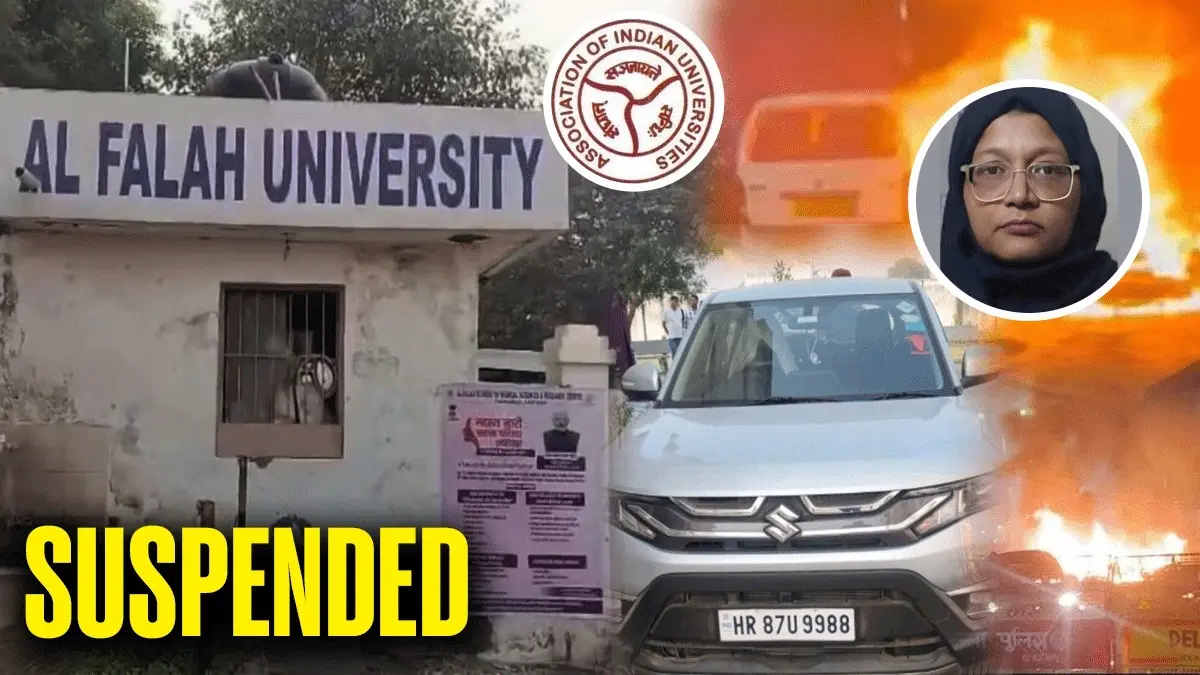
…. Since the blast near the Red Fort in Delhi, Faridabad’s Al Falah University has come under suspicion. It is being seen as a terrorist base. Dr. Umar Nabi, the main accused in the Delhi bomb blast, and some of his associates worked as doctors at this university. Several other doctors and employees working at this university are on the radar of investigative agencies. Investigative agencies are trying to understand how Al Falah University became a hideout for white-collar terror modules. The Enforcement Directorate (ED) has also found financial irregularities worth ₹415 crore at this educational institution.
The ED alleges that Al Falah University misrepresented its accreditation under Section 12(b) of the National Assessment and Accreditation Council (NAAC) and the UGC, and received government grants. The investigation revealed that Al Falah School of Engineering and Technology was accredited only from 2013 to 2018, and its “A” grade accreditation from the Department of Education was only from 2011 to 2015.
The university administration collected fees worth crores from students by claiming ‘A’ grade in its forms without renewal. It has also come to light that this university earned academic revenue of Rs 415.10 crore from the financial year 2018 to 2025. After 2018, the university’s revenue registered a rapid increase. While its annual revenue was only Rs 24.1 crore in 2018-19, it increased to Rs 81.10 crore in 2024-25. Apart from this, irregularities have also come to light regarding the hostel and mess fees of this university.
Al Falah University was established in 2014 under Act 21 of the Haryana Legislative Assembly. It was recognized by the UGC under Section 2(f) of the 1956 Act. The university also became a member of the Association of Indian Universities (AIU). It began offering undergraduate and postgraduate programs, as well as PhD-level programs. It is a matter of concern that a higher education institution responsible for preparing the best human resources for the country’s bright future has become a haven for white-collar terrorist modules. The Al Falah case has underscored the need for a thorough investigation of other similar educational institutions.
Naturally, questions are being raised about the regulatory bodies that accredit and monitor higher education institutions. There should be no hesitation in stating the fact that the emergence of a terrorist module in an accredited university reflects the indifference of regulatory bodies like the UGC, AICTE, and NCTE. The Al Falah case also reveals that the regulatory bodies lack a robust and effective monitoring system. If the monitoring system had been functioning properly, Al Falah University might not have become a hub for terrorists, nor would so many irregularities have been found there.
According to a statistic, there are 1,191 universities in the country. These include 502 private universities, 494 state universities, 57 central universities, and 138 deemed universities. The number of private universities is rapidly increasing. Clearly, their monitoring needs to be more intensive. This is especially so because the latest Terror Behavior Intelligence Report from Interpol and the Rand Corporation reveals that terrorism has reached a new turning point. Radicalization is now being spread through mobile phones, laptops, and other devices. The fact that doctors at Al Falah University were found to be on the path of terrorism clearly demonstrates the potential for highly educated and technologically skilled youth to become terrorists. Following the discovery of the white-collar module at Al Falah University, intelligence agencies must remain vigilant about the activities of other educational institutions as well.
During the recent Supreme Court hearings related to the Delhi riots, Additional Solicitor General SV Raju, representing the Delhi Police, cited the incident surrounding the explosion near the Red Fort and argued that when intellectuals become terrorists, they become even more dangerous. The exposure of the ecosystem involved in radicalizing highly educated students indicates a new threat to the country. This is the first time a UGC-approved educational institution has been found operating a white-collar terrorist module. Agencies suspect that this module intended to use hospitals in Kashmir as hideouts to stash toxic weapons.
We also cannot ignore the fact that despite the existence of regulatory bodies like the UGC, AICTE, and NCTE, cases of fake universities awarding degrees are frequently reported. The UGC releases a list of such fake universities every year. Some of them are even shut down. Yet, 22 fake universities operate in the country today, with 10 of these operating in Delhi alone.