Time to build the India of the future !!!!
Time to build the India of the future
In the new year, it cannot be overlooked that there is a constant challenge from terrorist elements on the borders. In such a situation, constant vigilance and caution are required. Similarly, the signs of natural disasters, such as climate change and the continuous rise in temperatures, highlight the complexity of the environmental crisis. The Indian knowledge tradition and value system emphasize balance and coexistence with nature.
- India’s economic power and technological progress increased.
- Social inequality, unemployment and climate change are major challenges.
- Inclusive development, skills and strengthening of democratic institutions are essential.
… India’s image as a strong nation has certainly blossomed over the past decade. As we contemplate the future of this changing India in the new year, we must keep in mind both the country’s rich ancient civilization and the concept of a modern nation-state. The image of Ramrajya, a symbol of ethical and just governance, remains indelibly etched in public memory. Therefore, while we must keep in mind aspirations compatible with globalization, we must also be concerned with standards such as morality, truth, and non-violence. Looking at the story of the country’s progress, we find elements of both continuity and change.
In this new year, we must soberly consider what a developed India will look like. Indian society is characterized by numerous diversities, leading some thinkers to question the nation’s fundamental unity. They forget that, in the Indian perspective, plurality is merely a manifestation of an underlying fundamental unity—”Ekam Sad Vipra Bahudha Vadanti.” The goal should be to discover and recognize this unity. The coexistence and mutual dialogue of diversity, based on close proximity within the entire animal kingdom, is the fundamental thinking of India. It is not without reason that the metaphor of family is central to our thinking. This vision is also essential for national unity, a sense of belonging, and patriotism.
The past year has been full of challenges for India. US policy has created challenges for India’s exports, the value of the rupee, investment, and balance of payments. President Trump’s aggressive pursuit of US interests has harmed us. In light of this, India has taken several steps to manage the situation. GST rates have been reduced and labor laws have been amended. It is a significant achievement that India’s GDP growth rate has remained among the highest in the world even in the face of dire international uncertainty.
Retail inflation also reached its lowest level in eight years. Strong production, improved supply chain conditions, and lower crude oil prices all contributed to this situation. Domestic investors in the stock market strengthened our economy. Income tax filings and tax collections also improved. New initiatives were taken in the areas of power, urban development, mining, and financial services. India is on its way to becoming a major global economic power and is projected to become the world’s third-largest economy by 2030 with a GDP of $7.3 trillion.
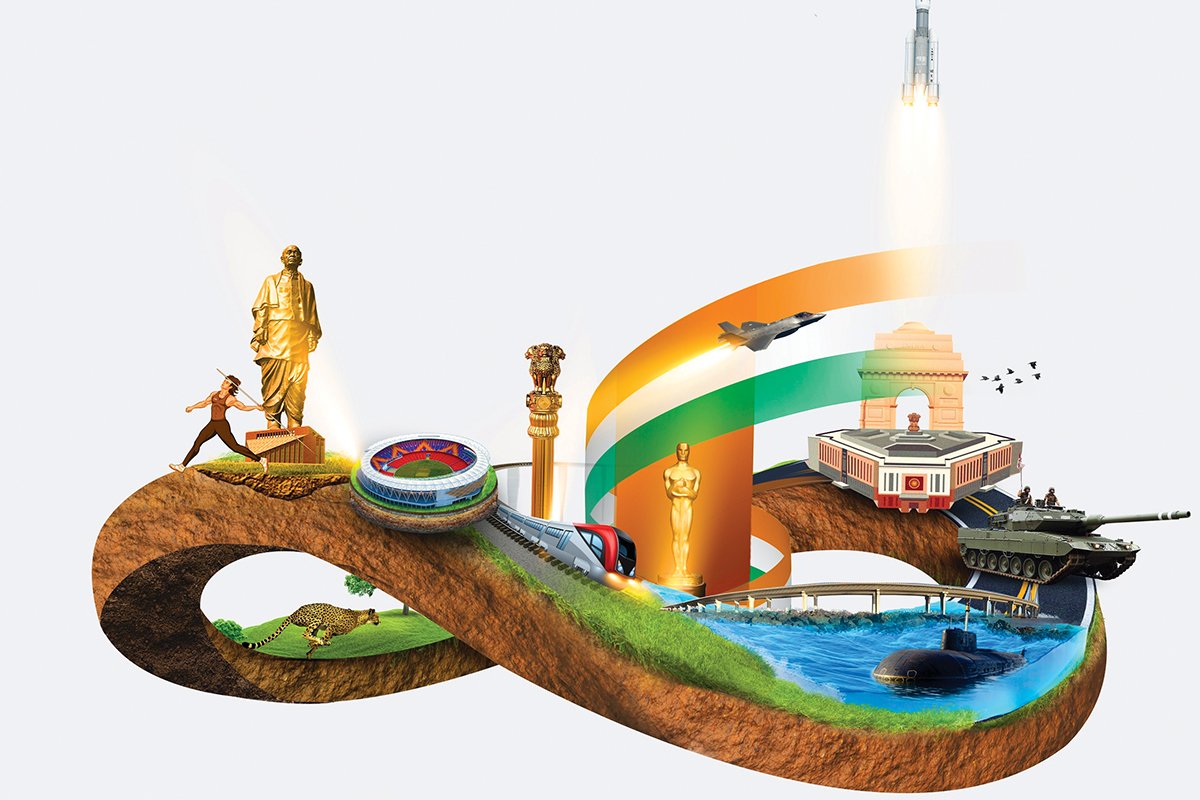
From a social perspective, the size of the middle class is growing in the country, leading to increased consumption and urbanization and a reduction in poverty. The country’s infrastructure is expanding. Progress is also being made in digital technology, artificial intelligence (AI), space science, metros, and bullet trains. The Made in India initiative is creating new employment opportunities due to the significant growth in manufacturing, IT, healthcare, and startups. The manufacturing sector is seeing potential for progress, and a policy of indigenous development is being adopted. It is anticipated that the use of 5G and robotics will expand. Online shopping and OTT platforms are becoming increasingly popular. The dominance of AI will increase further in the future. Cybercrime may also increase. Consequently, cybersecurity is becoming a crucial concern. It is also important to remember that the country’s future cannot be limited solely to indicators of economic progress. Economic development must be viewed not only in terms of growth rates, but also in terms of increased employment opportunities, social mobility, and improved living standards for the general public. To ensure a quality life for all, the economy must also become knowledge-intensive and more socially responsible.
There is opportunity for a self-reliant India, but we cannot ignore our limitations. Young India is often heralded as an asset, but this requires investment in skills, health, and education. Lack of skill development and youth unemployment are causing discontent in society. Serious efforts must be made to address the inconsistencies in the new education policy and implement it. Doubts remain about the accessibility, quality, and relevance of education. Similarly, public healthcare has also experienced challenges. Mental health facilities are inadequate. Female labor force participation remains low. Income and wealth inequality has also increased, and insecurity in the informal sector persists. Caste, class, gender, and regional disparities persist. Addressing these challenges will necessitate the inclusion of the excluded, otherwise, the cycle of political parties exploiting social polarization for electoral gain will continue. We must integrate pluralism and national unity.
In the new year, it cannot be ignored that there is a constant challenge from terrorist elements on the borders. In such a situation, constant vigilance and caution remain necessary. Similarly, the signs of natural disasters, such as climate change and the continuous rise in temperatures, highlight the complexity of the environmental crisis. The Indian knowledge tradition and value system have always emphasized balance and coexistence with nature. We must necessarily curb consumerism and adopt a lifestyle that is not inimical to the environment and sustainable development. India’s future is bright and full of possibilities, but it also faces challenges such as poverty, climate change, and social inequalities. It will also be necessary to increase public trust in democratic institutions and promote social dialogue and tolerance.