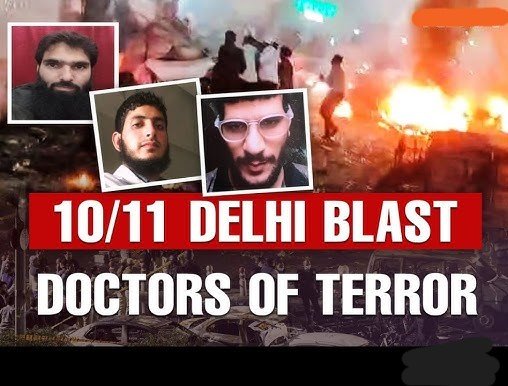
White-collar terrorism…Some B.Tech graduates… once professors and now doctors, this educated group is the new generation of generational terrorism.

White-collar terrorism poses a new and formidable challenge for security agencies. The name of a Kashmiri doctor is also prominently implicated in the explosion in front of the Red Fort in Delhi, and links are being established with Dr. Shaheen Siddiqui, a professor from Kanpur, in the blast that has claimed 12 lives so far.
Terrorist organizations that previously targeted undereducated, illiterate, or unemployed youth in Kashmir are now cultivating a crop of educated individuals in their schools. The terrorist incidents across the country in the last few years bear witness to the fact that individuals involved in terrorism are now working for terrorist organizations. Or rather, terrorists are recruiting them into their ranks.
Security agencies have cracked down on this issue in recent years. Now, they are considering this renewed trend a major alarm. Along with Hizbul Mujahideen, Lashkar, Jaish, and Ansar Ghazwat-ul-Hind have begun targeting such youth. After graduates, postgraduates, and those pursuing professional education, even doctors are now joining terrorism.
Former DGP SP Vaid says that since 2019, security agencies in Kashmir have significantly cracked down on the incitement of youth in the name of religion. Strictness and surveillance on social media and other platforms have been increased. Terrorist organizations employ new tactics, sometimes with success. A series of…
- These terrorists emerged from the violence that erupted in Kashmir after the killing of Burhan Wani and abandoned their studies to join terrorist organizations.
Zakir Rashid Bhat alias Musa
had studied B.Tech. He was the chief of Ghazwat ul Hind. He was an A double plus category terrorist.
Khurshid Ahmed Malik
was an engineering graduate turned terrorist. He was a resident of Pulwama. He had done B.Tech from Shri Mata Vaishno Devi University, Katra. He was killed in August 2018.
Mohammad Rafi Bhat
Mohammad Rafi Bhat was an assistant professor at Kashmir University. Then he became a terrorist. He was killed in an encounter in Shopian district in May 2018.
Zubair Ahmed Wani
He was an MPhil scholar. He was a resident of Dahruna village in South Kashmir. He was killed in an encounter. He was killed in 2021.
Mannan Bashir Wani
was a research scholar at Aligarh Muslim University. After Burhan Wani was killed, he joined the terrorist organization Hizbul Mujahideen and became a commander. He was killed in 2018.
Riyaz Naikoo
was a teacher at Gatiyan. After the death of Burhan Wani and terrorist commander Saddam, Riyaz became a famous terrorist. He was killed in an encounter in 2020.
Junaid Ashraf Sehrai
He had an MBA and then joined Hizbul Mujahideen. He was the son of Tehreek-e-Hurriyat chairman Mohammad Ashraf Sehrai. He was killed in 2020.
Educated people became terrorists in the past and continue to do so today. The terrorists who carried out the 9/11 attacks in America were educated. The four doctors arrested in the doctors’ terrorist module are residents of South Kashmir. South Kashmir is the stronghold of Jamaat-e-Islami, the organization’s ideology is anti-national. Pakistan initiated generational radicalization in Jammu and Kashmir after 1947. This continued for the last seven to eight decades. Generational radicalization peaked in 1990. In the last few years, development work and action against terrorism have reduced it. After the Pahalgam attack, Kashmiris took to the streets against terrorism and Pakistan, which reduced the level of radicalization, but generational radicalization continued. ISIS and Jamaat-e-Islami took advantage of this and selected individuals from South Kashmir, a stronghold of radicalization, who had no previous terrorist record, and these doctors became part of it.
-……retired