How were the exit polls done earlier, how much has it changed now?
The atmosphere was known from the places, Chaupals and gatherings… How were the exit polls done earlier, how much has it changed now?
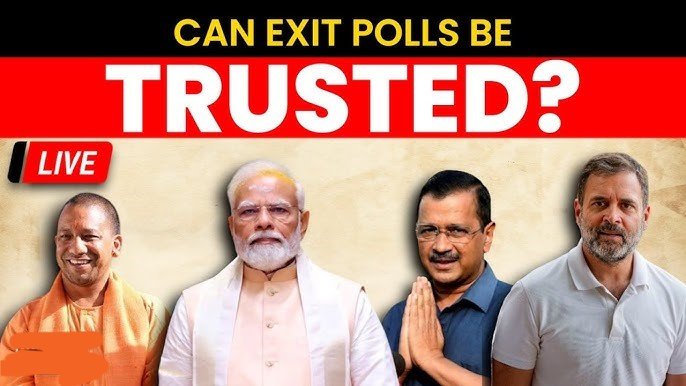
After both phases of voting in the Bihar Assembly elections, everyone is now preoccupied with predicting who will ultimately win and who will take the reins of power in Bihar. To this end, exit polls were conducted by various media organizations. Let’s explore when the era of surveys and exit polls began, and what role reporters played in predicting the results after the first election.
The 1989 Lok Sabha elections were a crucial election when people first heard the term poll survey. Although no agency apparently conducted any pre-poll surveys, and at that time, there were no such agencies conducting poll surveys. However, almost all reputable media houses sent their correspondents to remote areas to make projections. Newspapers used charts to visually depict voter sentiment. Until then, no private electronic news channel had been permitted in the country. The only focus was Doordarshan, a government-owned channel, which focused solely on entertainment. While there was news for half an hour at night, it was nothing more than government praise. Radio, also under government control, was more or less the same. Therefore, newspapers’ charts, used to present pre-election voter discontent, were visually appealing.
The Election Commission was an incorporeal body.However, until then, the Election Commission was a formless and unchanging institution. Its imposing and rigid form had not yet emerged. In those days, RVS Peri Shastri was the Election Commissioner. His and his predecessors’ job was to conduct elections, and an institution like the Election Commission was reluctant to experiment with anything new in this area. It would not be wrong to say that the Election Commission was a rather indecisive institution at that time.
Any retiring bureaucrat would be appointed Chief Election Commissioner, who would mechanically conduct the elections and then disappear from the news. Until then, no Election Commissioner had considered bringing any freshness or innovation to the electoral process. Nor did they ever realize that they were a constitutional institution of the country. During the election process, they could control all parties, including the ruling political party. Therefore, there was no discussion of opinion polls.
TN Seshan changed the faceAfter Peri Shastri, VS Rama Devi was appointed Election Commissioner and was relieved after just 16 days. He was succeeded by TN Seshan, who had been Cabinet Secretary during the Rajiv Gandhi government. However, when VP Singh became Prime Minister, a new Cabinet Secretary was sought. VC Pandey became Cabinet Secretary, and Seshan was removed from the post of Cabinet Secretary well before his retirement. He was made a member of the Planning Commission. As soon as Chandra Shekhar became Prime Minister, Seshan was asked to resume his position as Cabinet Secretary, but Seshan expressed reluctance.
He was then asked to accept the position of Chief Election Commissioner. After much deliberation, Seshan accepted the position and was appointed Election Commissioner on December 12, 1990. TN Seshan transformed the Election Commission. Even the most powerful leaders of every political party feared him. He reformed the entire electoral process and showed everyone what the Election Commission was.
The atmosphere before the exit polls beganHe is remembered for ensuring fair elections in the country. It was during his tenure that election surveys were approved. The first exit poll was conducted in the 1996 Lok Sabha elections. Even before this, election surveys were conducted, but they were either conducted by intelligence agencies or by political parties on their own. However, they were not made public. Media outlets also conducted opinion polls in a limited scope, but these were based on private efforts and estimates for a few constituencies.
Exit polls began appearing in 1996, as everyone’s attention was focused on the 1989 Lok Sabha elections. Rajiv Gandhi, who had won a landslide victory in the 1984 Lok Sabha elections, was being challenged by his own colleague, VP Singh, who had served as Finance Minister in his government. Arun Nehru and Arif Mohammad Khan were also leading the rebels. Therefore, everyone was interested in the 1989 elections.
The dangers of disclosing opinion pollsTelevision and radio were under government control. Even newspapers were afraid to publish opinion polls. It was considered unethical, and there was also the threat of being taken to court if the results didn’t meet expectations. But somehow, the message was conveyed to the public that a particular party had the upper hand. Before 1989, people were equally enthusiastic during the 1977 Lok Sabha elections.
The print media was at the forefront of creating a backlash against the Indira Gandhi government. The message was sent to the public that Indira Gandhi’s defeat was certain no matter what. Voters’ sentiments were also similar. At that time, people were so disgusted with the Emergency imposed by Indira Gandhi’s government that they voted against the Congress without any hesitation. The poll results were as expected.
Congress was left with no alternative but there was discord within the party.A similar atmosphere had prevailed during the fourth Lok Sabha elections (1967). There was considerable turmoil within the Congress party. The first Prime Minister, Pandit Jawaharlal Nehru, had died in 1964, and the second Prime Minister, Lal Bahadur Shastri, a year and a half later. Indira Gandhi, through manipulation within the Congress Parliamentary Party, defeated Morarji Desai and was elected leader, but she was forced to not only include him in her government but also grant him the status of Deputy Prime Minister. Morarji held the Finance Ministry.
His image was that of a pro-capitalist right-wing leader. Socialist-minded elements within the Congress party wanted to oust such leaders. However, at that time, there was no alternative to the Congress party in the country. Congress was the only political party with a nationwide presence, and within the Congress party, the Left, Right, and Centrists were all entrenched.
In 1967, the vernacular media warnedIn this environment, Congress won the 1967 Lok Sabha elections but lost its grip on the states. Lacking an alternative, it won 283 seats in the Lok Sabha out of a 523-member House. Elections were held for 520 seats. Until then, Lok Sabha and state assembly elections were held simultaneously. Congress secured a majority in the Lok Sabha, but its position deteriorated in seven states. The Swatantra Party prevailed in Gujarat, Rajasthan, and Odisha.
Left parties in West Bengal and Kerala, and the DMK in Madras state, allowed it to win only three out of 39 seats. Of the seven Lok Sabha seats in Delhi, Congress won only one, with the Jan Sangh taking the remaining six. It lost power in nine states across the country. National and vernacular media had already been reporting its dire situation, but they were ignored.
Local media penetrationUntil then, the views of so-called national newspapers were considered the most accurate. However, their reach and influence were limited. They had no sources in remote areas, nor did they take the local media seriously. Their reports were dismissed as rural or vernacular media. However, it was this vernacular press that was capable of making accurate decisions. Even local political leaders trusted these small newspapers in their area, knowing that the local newspaper journalist, who cycled from one place to another on a bicycle, visited every street and neighborhood, interacted with people as if they were family, and could gauge their innermost thoughts. Even then, people did not vote by word of mouth, leaving politicians unsure, but they too would relay the real verdict to the press reporter. This was the poll survey.
The reporter’s own boot is the poll surveyElection discussions were common at tea and paan stalls, in village and town squares, in gatherings of elders, and at gatherings of the wealthy. A press reporter might have limited resources, but he had immense reach. He could uncover accurate news, and thus, even expose the darkest thoughts within. Elections were conducted using ballot papers. Counting was often halted or slowed down. Results for individual constituencies would take two days. Until then, surveys by rural reporters would be published as projections. After the 1977 elections, these vernacular newspapers began sending their correspondents outside their circulation areas. When Indira Gandhi contested the Lok Sabha by-election from Chikmagalur, several vernacular newspapers covered this seat in far-off South India.