₹4 lakh crore bet on ‘AI data center’ in India ?
₹4 lakh crore bet on ‘AI data center’ in India, players like Reliance-Adani involved, how big is the game?
The game of AI data centers is a hot topic in India. Major business houses like Tata, Reliance, and Adani are investing billions of dollars in the race to outdo each other. But what are the benefits?
The data center market in India is growing rapidly due to the demand for data consumption, cloud computing, 5G, and AI. Currently, the country’s data center capacity is around 1-1.7 gigawatts, which is expected to reach 8-9 gigawatts by 2030, requiring an investment of approximately ₹4 lakh crore. This entire game is in the hands of major companies like Reliance, Adani, and Tata.
we understand what AI data centers are, how important they are for India, and how their market is growing in the country…
Question 1: What are AI data centers?
Answer: Before understanding the role of AI data centers in the Indian market, it’s important to understand them…
- You’ve probably heard of data centers, large buildings where millions of computers (servers) run 24 hours a day. They help you access Facebook and Instagram, search Google, and perform various online tasks, including banking.
- An AI data center is exactly the same, but specifically designed to run large-scale artificial intelligence (AI) applications like ChatGPT, Gemini, Grok, and Midjourney.
- Suppose your phone has a normal processor that performs 10 calculations per second. To run AI, you need a processor that can perform 10 trillion calculations per second. Such specialized processors are called GPUs or TPUs.
- Each GPU costs 30-40 lakh rupees. A rack holds 8-16 GPUs, and an entire server room has hundreds of racks.
- All this high-power power can cause servers to overheat, requiring cooling systems. GPUs can get so hot they could melt without cooling, so they’re cooled using liquid cooling. A 1-megawatt data center uses 25 million liters of water per year.
- To ensure uninterrupted power supply, backup generators and renewable energy sources like solar panels are installed. A typical data center consumes 10-20 megawatts of power. An AI-powered one can consume 100-500 megawatts, which is enough to power a small town with a population of 50,000.
- Security includes biometric access, fire suppression, and cyber walls. Overall, these centers operate 24/7, keeping data encrypted and connecting users worldwide via cloud services.
If you use an AI image generator like Google Gemini, it runs in the background in one such AI data center, where thousands of GPUs work together to process your query. These centers not only store data but also perform real-time calculations, such as helping a doctor analyze a patient’s report with AI or a farmer run an AI model to predict the weather.
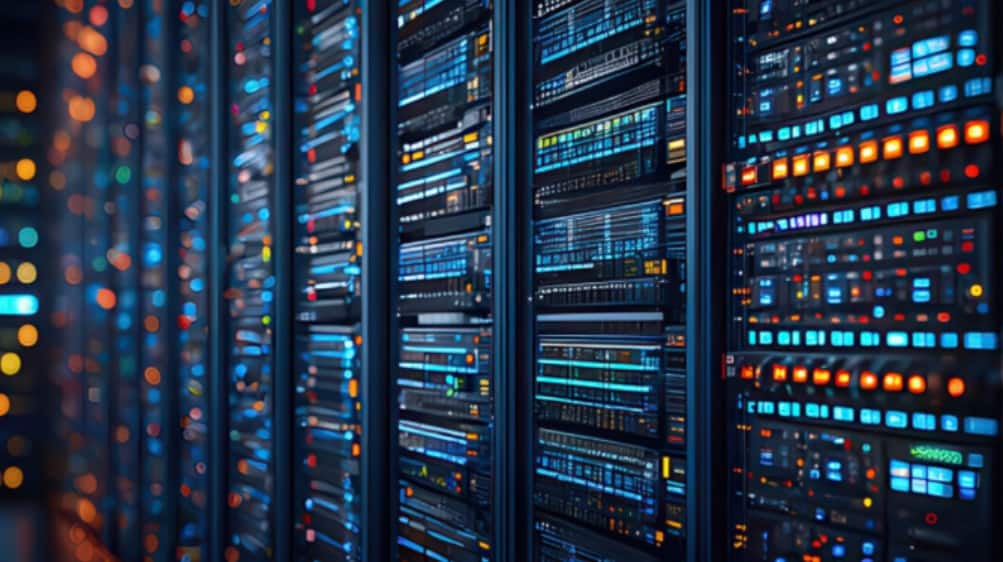
Let’s understand this with a simple example: Imagine a large library housing thousands of books. Now, a robot with a super-brain is reading all those books and writing new ones on its own. To operate this robot, a very powerful brain, i.e., a GPU, requires a lot of cooling, and a lot of electricity. Together, this is called an AI data center.
Question 2: How do these centers work?
Answer: AI data centers operate like a supercomputer factory, where every part runs in perfect sync…
- First, there is the data input, which can be anything like text, images, video, or sense data.
- This data comes to the centers through high-speed networks, which are connected by fiber optic cables.
- Then comes the core part, that is, thousands of server racks, where GPU or TPU chips are installed.
- These chips perform parallel processing, meaning they perform millions of calculations simultaneously.
- This process occurs in two stages: training, where the model is taught by showing it past data, and inference, where it answers new queries in real-time.
- That means when you get smart suggestions from AI in Google Search, it comes from a center in the background where the data is processed in seconds.
Question 3: What is the status of existing AI centers in India?
Answer: As of November 2025, there will be approximately 150 operational centers in India, most of which are or are becoming AI-ready. The total capacity is 1.7 gigawatts, covering 23 million square feet of space. However, AI-focused centers are still few due to their high power demands, meaning only about 1 gigawatt is AI-optimized.
- Currently, the main ownership in the country is with Indian conglomerates and global hyperscalers.
- Tata Communications and TCS have 13 centres with a capacity of 400 MW in Mumbai, Bangalore, Chennai and Delhi.
- Reliance Industries (through Jio) has a 1 GW AI centre in Jamnagar, Gujarat.
- Adani Group’s AdaniConnex has 40 MW of operational AI data centres in Chennai, Hyderabad, Mumbai and Pune.
- Bharti Airtel’s Nextra holds 15% market share in Chennai and Delhi-NCR with 400 MW capacity.
These include NTT GDC (20% share, 30 centers), STT GDC (19%), Sify (19%), ControlS (over 250 MW), and Yotta (175 MW). Among locations, Mumbai-Chennai controls 70% of the capacity due to the presence of undersea cables. Delhi-NCR, Hyderabad, and Pune are emerging hubs. Hyperscalers like Google, Microsoft, and AWS account for 60% of the consumption. All this supports Digital India, where monthly data consumption has reached 25 exabytes.

Question 4: What is the AI data center sector in India and how is it growing?
Answer: According to tech experts, the AI data center sector in India is currently the hottest topic, with the country’s largest businesses, such as Tata, Reliance, Adani, and Airtel, investing billions of dollars in a race to outdo each other. It’s a race to make India the world’s next AI superpower. But it’s not that easy. Nevertheless, the sector is projected to be worth $10 billion by the end of 2025. By 2030, it’s expected to reach $27 billion with annual growth of 42%.
According to a CRISIL report, the sector’s annual revenue will reach ₹20,000 crore by FY28, and capital expenditure (capex) will be ₹55,000-65,000 crore between FY26-28. A Jefferies September 2025 report states that India’s total data center capacity, currently 1 GW, will reach 8-9 GW by 2030.
Hyperscalers like Google, Microsoft, and AWS control 60% of demand, while the BFSI sector contributes 17%. The government’s draft National Data Center Policy 2025 offers 20-year tax breaks, which is attracting investors. Mumbai and Chennai handle 70% of the capacity, but locations like Visakhapatnam (Vizag) are emerging as new hotspots. Overall, this game is the engine driving India’s digital economy to $1 trillion, with the AI market expected to reach $22 billion by 2027.
Question 5: Who are the major players in this game?
Answer: Tata, Reliance, and Adani are leading the AI data center market race. Together, they will control 35-40% of the capacity by 2030. These three companies are not only building AI-ready centers but are also focusing on Nvidia chips, green energy, and submarine connectivity. This isn’t just an investment game; it will create millions of jobs, boost GDP by 10-15%, and make India a global AI hub.
Data consumption from 5G and the cloud has reached 25 exabytes per month. By 2030, power demand from AI will account for 2.6% of electricity use. With government support, states like Andhra Pradesh are offering incentives. However, the additional demand for 50 TWh of power supply by 2030, water use, and high capex are major challenges, which are being addressed through renewable energy.
1. Tata’s investment
- TCS launched HyperVault AI Data Centre Ltd., a joint venture with TPG, in October 2025. This will involve an investment of approximately ₹18,000 crore to build 1 GW of capacity over 5-7 years. TPG added an additional $1 billion in November 2025. These centers will be located in hubs like Mumbai, Bengaluru, and Chennai, with a focus on AI-sovereign data, meaning India’s data will remain in India.
- The joint venture will focus on liquid cooling and green energy, which will manage the high heat generated by AI. Tata already operates 13 centers with a combined 400 MW capacity, but this new plan will take AI to the next level. This investment will allow TCS to overtake US big tech giants, as the Tata Group is leading a large portion of the total $28 billion investment.
2. Reliance Investment
- This company is the most aggressive player. Reliance has planned a 3 GW mega AI center in Jamnagar, Gujarat, with an investment of $20-30 billion, running on Nvidia AI chips. This campus will be spread over 5,000 acres, powered by 6 GWp of solar power, and will make AI inference affordable. Integrated with Jio’s telecom and cloud capabilities, it will become Asia’s largest AI network.
- In November 2025, Reliance’s joint venture, Digital Connexion (with Brookfield and Digital Realty), announced an $11 billion investment in Visakhapatnam. The project, to be completed in Andhra Pradesh by 2030, will have a capacity of 1 GW. This $11 billion investment will shape India’s AI supply chain, boosting data centers, cloud, and edge computing.
3. Investment by Adani Group
- Gautam Adani’s company announced an additional $10 billion investment in April 2025 to drive AI demand. The 40 MW operational capacity in Chennai, Hyderabad, Mumbai, and Pune will expand to 210 MW through a 50-50 partnership with AdaniConneX and a joint venture. Maharashtra initially had a plan of ₹50,000 crore.
- The biggest breakthrough came in October 2025, in collaboration with Google. By 2030, a $15 billion, 1 GW AI campus will be built in Vizag, based on 100% renewable energy. It will be TPU/GPU based and will create approximately 200,000 jobs.
Bharti Airtel is not far behind in this race. Nxtra Data has a 15% market share and plans a $15 billion deal with Google for a 400 MW capacity data center in Vizag.