
Heat stress will increase in the coming years !!
Climate change in India will lead to a significant increase in the number of unbearable heat and heat stress days in the coming years. According to a study, there could be more than 50 heat stress days per year by 2041-2070, severely impacting health, agriculture, and the economy. Coastal and northern regions are at greater risk, and temperatures in cities could rise by up to 7 degrees Celsius. This will increase the risk for the poor, children, and the elderly.

- 50+ heat stress days possible in India by 2041-2070.
- Increasing heat has serious impact on health, agriculture and economy.
- Temperatures are expected to rise by up to 7 degrees Celsius in urban areas.
New Delhi, Climate change is causing temperatures to rise worldwide. In a global temperature model-based study published in the journal Nature, scientists have predicted that people in India could face unbearable heat in the next few years. By 2041–2070, the number of days with extreme heat stress in India could exceed 50 days per year compared to 1971–2000. Rising temperatures and humidity will create extremely dangerous conditions for humans. If carbon and greenhouse gas emissions remain at such high levels, the number of days with extreme heat and heat stress could increase to 75 or more. Heat stress will increase, especially during summer and before the onset of monsoon. This will not only increase health risks but also impact agriculture, energy, and urban life.
Scientists have predicted that by 2041–2070, the number of days with a heat index above 27 degrees Celsius in the country could exceed 50 days per year. Whereas the number of days with extremely dangerous level of 32 degrees can be 5 days or more. Dr. Ankit Agarwal, a scientist from the Department of Hydrology, IIT Roorkee, who was involved in the study, says that in the coming years, people may have to face unbearable heat as compared to the average of 1971–2000. The increase in heat will not only increase health risks, but will also have a serious impact on agriculture, electricity demand, work and public health services. Heat stress can increase to extremely dangerous levels in India, especially in the coastal and northern areas.
The report claims that due to the effects of global warming, people living in major Asian cities like Delhi, Seoul, Tokyo, Beijing, Karachi, Dhaka, Manila, and Jakarta will face extreme heat in the coming years. Due to the urban heat island effect, these cities will experience temperatures ranging from 2°C to 7°C higher. This will significantly increase the demand for healthcare, drinking water, and cooling equipment. The risks for children, the elderly, and outdoor workers living in poor and densely populated areas will increase manifold.
Engineer Tiwari, Lead, Climate Resilience and Health, NRDC India, says that temperatures will definitely rise in the coming years. We need to prepare for this now. We studied heatwave-related deaths in ten major Indian cities between 2008 and 2019. We found that, on average, approximately 1,116 people died each year due to heatwaves. In such a situation, the increasing heat every year can create major problems in the future. We need to prepare for health emergencies from now on, keeping the heat in mind. Immediate steps need to be taken to provide relief to the general public in a heatwave situation. Long-term planning also needs to be implemented. Rising heat impacts not only humans, but also animals, birds, industry, and the economy. Children, the elderly, and those in need of special care must be taken care of. Long-term plans require increasing green cover, increasing the number of water bodies, and reducing the use of concrete. Cities become urban heatlands in the summer, and steps must be taken to reduce temperatures there.
Heat waves should not be taken lightly; they can even be fatal. According to Dr. Narendra Saini, Chairman of the Scientific Committee of the Delhi Medical Council, most of our body’s organs function optimally at 37 degrees Celsius. As temperatures rise, their functioning will be affected. Exposure to extreme heat will increase body temperature, leading to organ failure. The body will start burning, and the increased body temperature will reduce the functioning of other organs, including the brain and heart. If someone feels hot, immediately take them to a shady place. Place a cloth soaked in cold water over their entire body. If the person is conscious, give them water mixed with electrolyte or sugar and salt. If there is a hospital nearby, immediately take the person to the hospital.
According to Rohit Magotra, Deputy Director of Integrated Research and Action for Development, the frequency and intensity of heat waves are likely to increase in the 21st century. The recent 6th IPCC report has warned of the Earth’s surface warming by around 2.0 degrees Fahrenheit (1.1 degrees Celsius). This will lead to an increase in the global average temperature and heat waves in the future.
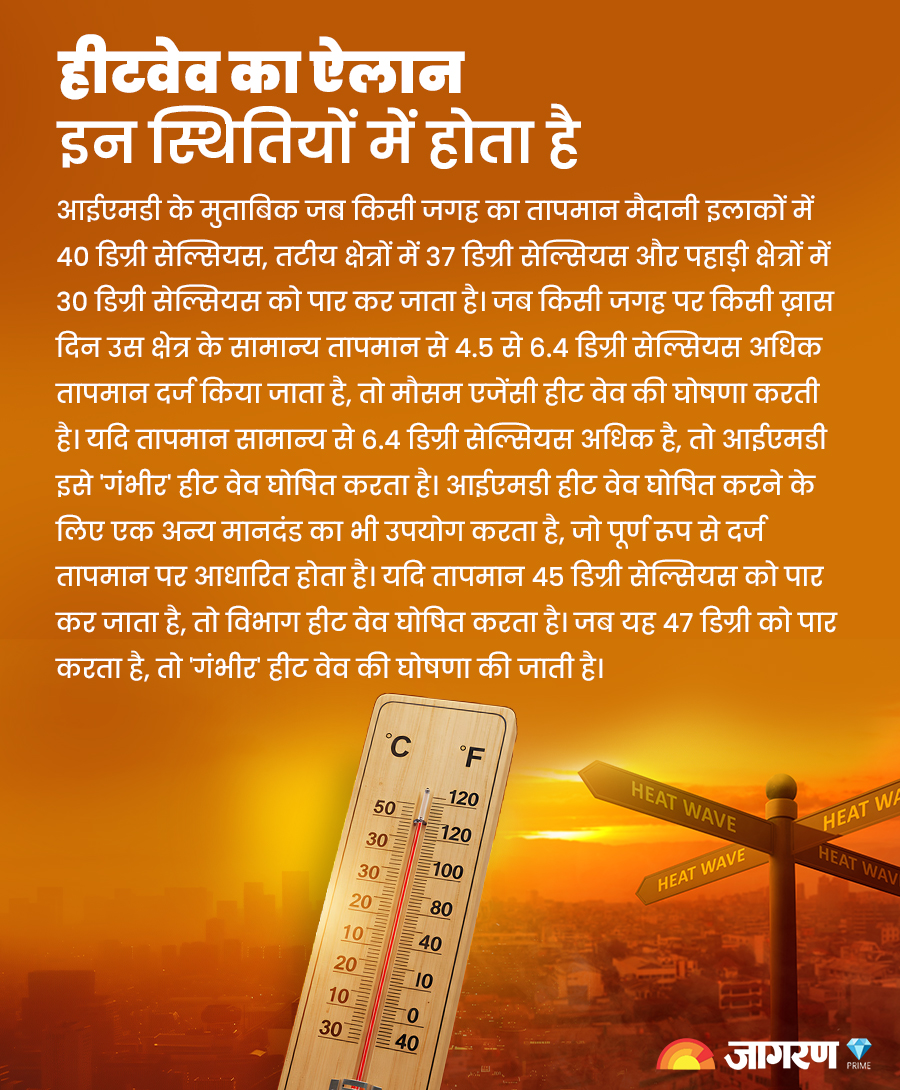
According to the International Monetary Fund (IMD) , a heat wave is declared
when the temperature in a location exceeds 40 degrees Celsius in the plains, 37 degrees Celsius in coastal areas, and 30 degrees Celsius in mountainous regions. When a location records a temperature 4.5 to 6.4 degrees Celsius higher than the normal temperature for that area on a given day, the weather agency declares a heat wave. If the temperature is 6.4 degrees Celsius higher than normal, the IMD declares it a “severe” heat wave. The IMD also uses another criterion for declaring a heat wave, based solely on the recorded temperature. If the temperature exceeds 45 degrees Celsius, the department declares a heat wave. When it exceeds 47 degrees Celsius, a “severe” heat wave is declared.
Climate change has increased heat across the world. Meteorologist Samarjit Chaudhary says that changes in weather are being seen worldwide due to climate change. Many studies predict that temperatures will increase further in the coming days, and extreme weather conditions will be observed. In such a situation, action is needed to address the severity of the situation. According to Europe’s Copernicus Climate Change Service, temperatures during March 2024-February 2025 were 0.71 degrees Celsius higher than the 1990-2020 average and 1.59 degrees Celsius higher than pre-industrial levels.
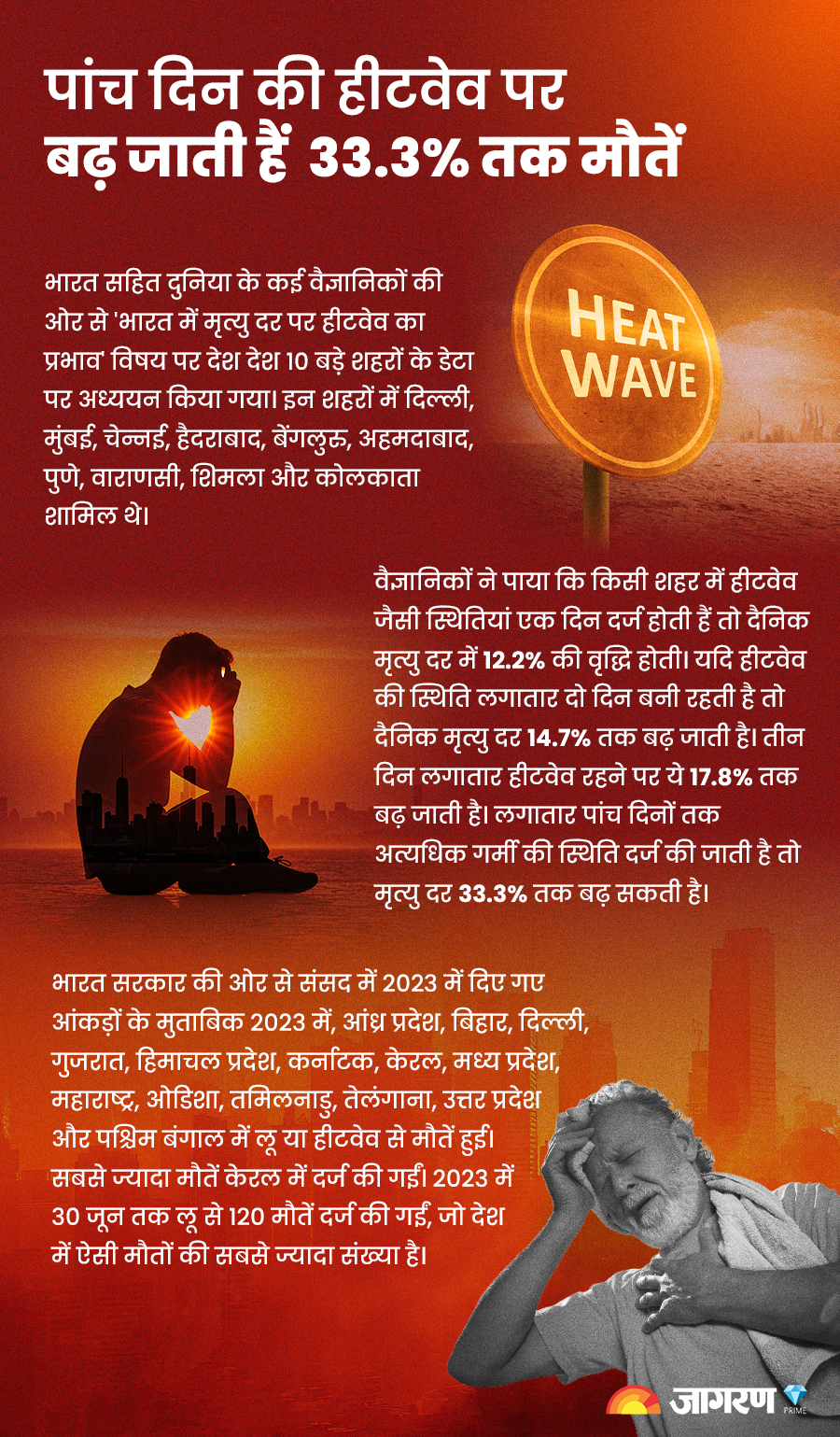
Deaths increase by 33.3% after a five-day heatwave.
Several scientists from India and the world studied the data of 10 major cities across the country on the topic ‘Impact of heatwave on mortality rate in India’. These cities included Delhi, Mumbai, Chennai, Hyderabad, Bengaluru, Ahmedabad, Pune, Varanasi, Shimla and Kolkata. Scientists found that if heatwave-like conditions are recorded in a city for one day, the daily mortality rate increases by 12.2%. If heatwave conditions persist for two consecutive days, the daily mortality rate increases by 14.7%. If heatwaves persist for three consecutive days, it increases by 17.8%. If extreme heat conditions are recorded for five consecutive days, the mortality rate can increase by 33.3%. According to data presented by the Government of India to Parliament in 2023, heatwave deaths occurred in Andhra Pradesh, Bihar, Delhi, Gujarat, Himachal Pradesh, Karnataka, Kerala, Madhya Pradesh, Maharashtra, Odisha, Tamil Nadu, Telangana, Uttar Pradesh, and West Bengal. Kerala recorded the highest number of deaths. As of June 30, 2023, 120 heatwave deaths were recorded, the highest number in the country.