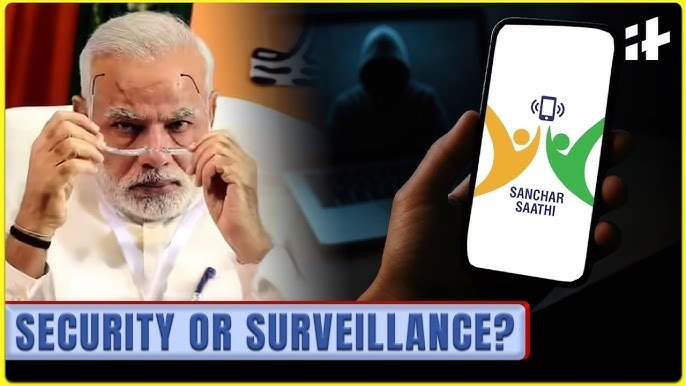
Modi government backtracks on intrusion into citizens’ privacy!
Modi government backtracks on intrusion into citizens’ privacy! Learn everything about the Sanchar Saathi app, both dangerous and beneficial.
The central government had ordered the Sanchar Saathi app to be made compulsory on every phone. When the opposition protested, the government reversed its decision. Why is this one app causing such a stir?
In May 2023, the Central Government’s Department of Telecommunications (DoT) launched the Sanchar Sathi web portal. This initiative was initiated under the Telecom Act 2023. The app was then launched on January 17, 2025, and has been downloaded more than 50 million times to date. Recently, the government directed all mobile companies to pre-install the app on every phone manufactured from 2026. However, the opposition launched a campaign against the app, calling it a new form of “Big Brother”-style government surveillance, after which the government significantly changed its decision.
what the Sanchar Sathi app is, how necessary it is for every Indian’s phone, and what the uproar is about…
Question 1: What is the Central Government’s new Sanchar Saathi app?
Answer: The Sanchar Saathi app is a citizen-centric cybersecurity tool from the DoT designed to protect mobile users from fraud, theft, and misuse of telecom resources. It is available as both an app and a web portal ( www.sancharsaathi.gov.in ). According to the DoT, the app performs functions such as checking the validity of International Mobile Equipment Identity (IMEI) numbers, reporting suspected fraud, blocking lost or stolen phones, checking mobile connections registered in your name, and verifying trusted contact details from banks.
As of July 2025, it has blocked 4.216 million mobile phones, traced and recovered 2.614 million stolen or lost phones, and received over 28.9 million connection verification complaints. The DoT says the app is a powerful tool to prevent cybercrime, especially with India’s mobile subscriber base of over 1.2 billion.
Question 2: How will this app work on your phone?
Answer: The Sanchar Saathi app works in a user-friendly manner, with multiple features integrated into one…
- After installing the app, you will have to register, which includes mobile number, OTP verification and optionally name or uploading documents.
- To check the IMEI, you need to manually enter the 15-digit IMEI number of your phone.
- The app will match it with DoT’s Central Equipment Identity Register (CEIR) system and tell whether the phone is genuine or blacklisted or stolen.
- If your phone is stolen, to block it, you will need to submit a police report, duplicate SIM and a form.
- DoT will block the IMEI on all operators within 24 hours and if the phone is used elsewhere, a traceability alert will be sent to the police.
- There is a ‘Chakshu’ feature for fraud reporting, where the user reports suspicious calls, SMS, WhatsApp messages or malicious web links along with details, screenshots and OTP.
- The DoT verifies this and, if the report is valid, sends it to the relevant telecom service provider (TSP), which initiates re-verification. Failure to do so results in the connection being suspended.
- TRAI rules apply for Unsolicited Commercial Communication (UCC) or spam.
- The app asks for permissions such as call/SMS logs, camera and file access to automate reporting, such as sending an SMS to trigger re-verification.
- A police report has to be submitted to unblock the recovery.
Overall, the app is linked to DoT’s digital intelligence platform, which shares reports with law enforcement and banks, but maintains the privacy of the reporter.
Question 3: What will be the regulations regarding the Sanchar Saathi app?
Answer: On November 28, 2025, the DoT issued a strict directive under the “Telecom Cyber Security Rules, 2024” (Revised), which applies to all mobile handset manufacturers and importers. According to this, within 90 days, all phones manufactured or imported for use in India must have the Sanchar Saathi app pre-installed.
The app must be clearly visible to the user during phone setup, easily accessible, and no functionality can be disabled or restricted. Manufacturers must push the app via software updates to phones already on the market. A compliance report must be submitted to the DoT within 120 days, failing which non-compliance may result in penalties under the Telecom Act 2023, the TCS Rules 2024, and other laws.
Activities like IMEI tampering are non-bailable offenses, punishable by up to three years in prison, a fine of up to 50 lakh rupees, or both. TRAI’s TCCCPR 2018 regulations cover UCC reporting, where complaints received within seven days are actionable. DoT has clearly stated that these regulations apply to all devices with IMEIs, including feature phones, to strengthen cybersecurity.
Question 4: How will this app monitor every phone?
Answer: The Sanchar Saathi app isn’t a direct “surveillance” tool, but rather a report-based system that takes action on user reports. However, the opposition and privacy advocates consider it a gateway to government surveillance, as the app requests extensive permissions such as IMEI, calls, SMS logs, camera, files, and phone management.
According to the DoT, these permissions are solely to facilitate reporting. The DoT verifies frauds reported through the “Chukshu” feature and forwards them to TSPs, which then suspend/disconnect connections. Traceability alerts on blocked IMEIs from the CEIR are sent to the police. The app stores data on the DoT’s digital intelligence platform, which is shared with law enforcement and banks. However, the DoT claims privacy, meaning the reporter’s identity remains hidden and the app doesn’t perform continuous background monitoring.
Question 5: What is the issue with installing the Saarthi app on Apple phones?
Answer: The main issue with Apple phones is iOS’s strict privacy policy and closed ecosystem. The DoT order applies to all brands, including Apple, Samsung, Xiaomi, and Vivo. However, Apple has previously opposed pre-installed apps, as iOS emphasizes user choice and privacy. The app is already available on the Apple Store, but pre-installation would require Apple to make system-level changes to iOS, which could conflict with the company’s global policies.
According to media reports, companies like Apple may challenge the 90-day deadline, as it doesn’t fit their business model. iOS has a 4.5% market share in India, but this could impact the premium segment.
Question 6: Why is the opposition against this app, and what has been the outcome of the protests?
Answer: Since December 1st, the opposition has been protesting the decision to make the app mandatory. They say this is a new form of “Big Brother”-style government surveillance, where imposing a permanent app on every phone violates constitutional rights. Congress leader KC Venugopal called it “unconstitutional” because the uninstallable app violates Article 21 (right to privacy). He linked this to the Pegasus spyware and VPN bans.
Shiv Sena MP Priyanka Chaturvedi called the Sanchar Saathi app a “Big Boss surveillance moment,” while Aditya Thackeray called it a “digital dictatorship.” The opposition argues that the app’s deep permissions could lead to misuse of user data and pose a threat to democracy.
Due to strong opposition from the opposition, the central government announced major changes to the app. On December 2, Union Telecom Minister Jyotiraditya Scindia said, “If users don’t want the Sanchar Saathi app on their mobile phones, they can remove it. It’s optional. It’s our duty to introduce this app to everyone. Whether or not to keep it on their devices is up to the user.”
Whereas previously, it was mandatory to keep this app on your phone, meaning it could neither be deleted nor uninstalled.
Question 7: Do Indians really need the Sanchar Saathi app?
Answer: Yes, they do, as telecom fraud is a major problem in India. DoT data clearly shows that cybercrime is causing billions of rupees in losses annually. Such as financial fraud through fake calls, the use of stolen phones for crime, and spam international calls, leading to 13.5 million illegal routings. The app has already recovered over 700,000 lost phones, disconnected 30 million fraudulent connections, and taken 40.96 lakh actions on 6.49 lakh fraud inputs.
Blacklisted phones are common in the second-hand market, making the buyer a criminal. TRAI’s TCCCPR regulations require spam prevention, and the app provides easy reporting for users. The DoT argues that this is citizen-empowering, meaning users can check their own IMEI.
Question 8: Can the Sanchar Saathi app have any disadvantages?
Answer: This app can have some disadvantages…
- Major privacy threat: The Sanchar Saathi app requires deep access to the phone to function, allowing constant monitoring of personal activity. The app is connected to a digital intelligence platform that shares your information with police and banks. It has been compared to Russia’s Max app, where pre-installed state apps have increased mass surveillance.
- Vulnerabilities and Third-Party Misuse: While the app itself is meant to be cybersecurity-friendly, it can pose risks. If the app contains a bug or vulnerability, it will increase the phone’s attack surface. Hackers could target government apps, potentially increasing the risk of data leaks.
- Pressure on manufacturers: Smartphone companies will have to comply within 90 days, which will create operational challenges, especially in closed systems like iOS. Manufacturers have warned that this will introduce significant hurdles such as software changes and testing. While checking blacklisted phones in the second-hand market is beneficial, mandatory apps will increase costs, which consumers will have to bear in the form of more expensive phones.