Why are opposition parties the target before elections?
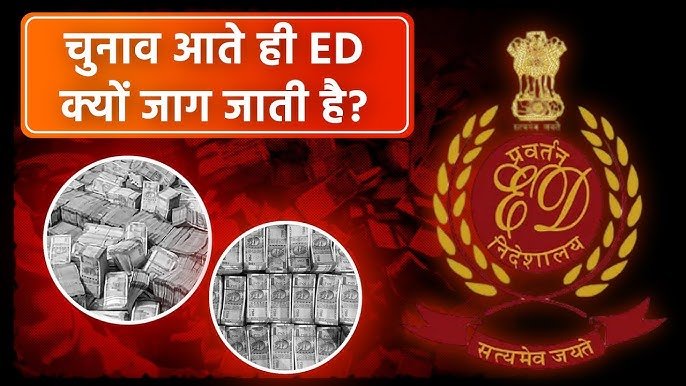
Do the ED and other investigative agencies target the opposition just before elections? Prima facie, the ED’s argument—and that of the BJP—on this question seems theoretically sound: action in corruption cases cannot be determined by election cycles. If wrongdoing is apparent, investigations should be conducted regardless of the political calendar. It should not be stalled for anyone’s convenience.
But is it merely a coincidence that opposition parties are consistently targeted before elections, while the ruling party at the center doesn’t face such scrutiny? The Constitution mandates that investigative agencies operate without fear or favor. They fulfill their duties rather than seeking political advantage. Yet, a look at the political narrative of the past decade reinforces the belief that the ED and CBI are acting more as tools of politics than as instruments of justice.
Public perception in politics shapes the behavior, trust, and sense of fairness on which democratic competition rests. When millions of voters begin to perceive the electoral playing field as uneven, both the legitimacy of the results and democratic conscience are threatened. Therefore, the perception of bias by central agencies should not be seen as a mere complaint; it is deeply rooted in the spirit of equal participation in democracy.
The raid on TMC’s political consultancy firm, I-PAC, ahead of the West Bengal elections has only strengthened this perception. The case is currently pending in court. AAP also faced similar ED and CBI action between state and central elections. During the 2021 Tamil Nadu Assembly elections, income tax raids were conducted on family members of DMK chief MK Stalin, and several ministers were also investigated by the ED.
It’s difficult to separate such actions over the past decade from the electoral landscape. It’s clear that investigative agencies don’t operate in a political vacuum. Especially during elections, when they take action against prominent politicians—whether intentionally or accidentally—the political consequences are inevitable.
An analysis of data available since 2014 shows that nearly 95% of the cases filed by the CBI and ED are against opposition leaders. ED operations have also seen a significant increase. The number of ED raids, which ranged from around a hundred in the decade leading up to 2014, reached thousands in the decade following 2014.
And this is despite the fact that 29 out of 72 ministers in the current Union Council of Ministers (about 40%) have criminal cases against them. These ministers themselves have disclosed this information in their affidavits to the Election Commission. These include charges such as murder, attempted murder, kidnapping, theft, and fraud. Have these cases been investigated with the same rigor and speed?
This systematic pressure on one side of the political spectrum may not necessarily prove intentional, but it certainly reinforces the perception of inequality. In a system where trust in institutions is already low, such perceptions translate into deep doubts about the fairness of democratic competition.
It should be noted that we are not debating the merits of the allegations here. Investigations are necessary for this. However, in any democracy, if one party takes full advantage of institutional neutrality and the other party continues to face scrutiny even during the election campaign, the concept of equal opportunity is weakened.
Allegations of misuse of central agencies are not merely personal matters; it is a question of trust. Trust—trust in fairness, equality before the law, and integrity in democratic competition. When this trust is broken, the pressure is felt throughout the democratic system.
In such a situation, any democracy must ask itself a profound question: can our institutions be both powerful and impartial? If not, they need reforms. For example, clear legal safeguards, independence of appointment processes, robust judicial oversight, and transparent protocols regarding timelines for action in the context of electoral processes.
When voters perceive the electoral playing field as uneven, both the legitimacy of the results and democratic conscience are threatened. Therefore, the perception of bias by central agencies should not be viewed as a complaint.