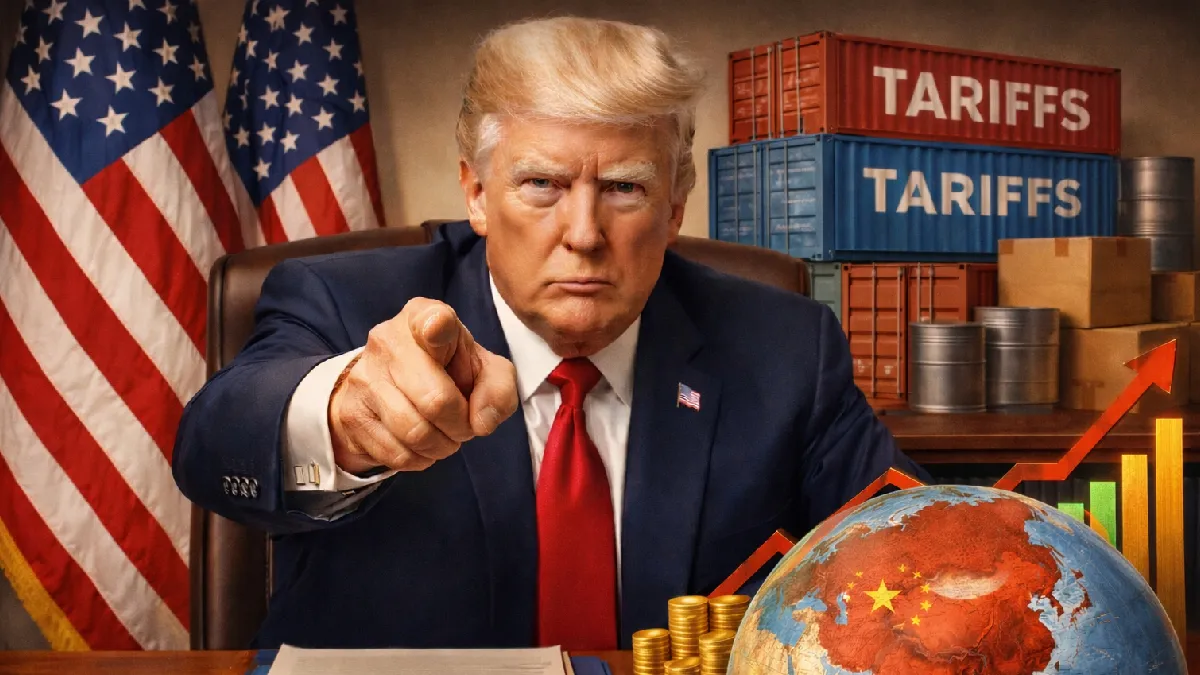
The world is troubled by Trump’s attitude !
The world is troubled by Trump’s attitude, he is ignoring traditions.
Trump’s foreign policy not only challenges the fundamental tenets of America’s traditional role in the world, but also shakes broader assumptions underlying the modern world order. Once a guide to others, America is now abandoning the established traditions it once championed. The implications of this change will be far-reaching.
- Trump’s policies dramatically changed the global structure
- Aggressive stance taken on Iran and Greenland
- Challenges to traditional American roles and global assumptions
Harsh V. Pant. One year has passed since Donald Trump’s second term as US President. During this one year, his dramatic policies have transformed the global landscape. Even America’s traditional allies have become somewhat perturbed by his unpredictable behavior. Trump, who spent months lobbying for the Nobel Peace Prize, has adopted a new approach at the start of the new year.
Trump, who successfully overthrew the government in Venezuela within hours on January 3rd, subsequently began to display aggression toward Iran and Greenland. He also warned against the brutal suppression of uncontrolled protests in Iran in recent days, warning that he would not hesitate to take harsh measures if the regime tightened its grip. When reports emerged of thousands of protesters being killed, Trump declared that the US was fully prepared to take action and that Iran would pay a heavy price.
For this, he also cited the example of targeting Iran’s nuclear sites last year. The Iranian establishment has denied the allegations of killing protesters and hanging arrested people, and Trump also cited his personal sources that nothing like this is happening. It is a different matter that the Trump administration has imposed new and strict sanctions on those individuals and organizations in Iran who are accused of suppressing protesters and black marketing of oil in the foreign market. Not only this, he also sent a strong message to Iran and its allies by imposing an additional 25 percent tariff on countries trading with Iran.
Beyond Iran, the Greenland issue appears to be even more important to Trump. This is because it appears to be escalating conflict with the very countries that have been close allies of the United States since World War II. Trump is tearing apart that very affinity with these countries. He posted an AI-generated image stating that Greenland will become part of the United States starting in 2026. This view of Trump’s toward Greenland is not new. Even during his first term, the Greenland issue was a central focus of his “national security strategy.”
This is often presented as the “Donro Doctrine.” They view the Arctic region as a vital strategic frontier that must be brought under US control by any means necessary. The Trump administration also justifies this stance in terms of power competition. Trump has repeatedly stated that Greenland is surrounded by Russian and Chinese ships and lacks the military capability to resist any attempt to occupy it. The ambitious “Golden Dome” project Trump is pursuing for US security will also require Greenland’s land to be implemented.
Beyond its strategic advantage, Greenland is also highly valuable from a resource perspective. The island is a treasure trove of rare minerals and uranium, which are used to manufacture everything from critical tools for environmental adaptation to advanced defense equipment. Although Trump doesn’t tout this as much, the appointment of a special envoy to Greenland and the promotion of the “Make Greenland Great Again” Act in the US Congress indicate his deep interest in exploiting the island’s resources. This is why Trump proposed giving each Greenlandic citizen between $10,000 and $100,000 to urge them to secede from Denmark and join the US. However, his proposal has been rejected by both civil society and policymakers.
Another significant change Trump made regarding Greenland was that in 2025, he placed it under Northern Command (NORTHCOM) instead of European Command (EUCOM). The main idea behind this was to view Greenland as a defensive shield for North America, rather than a part of Europe. While Greenland is geographically part of North America, its connection to a European country has led to its distinct perspective. As for NORTHCOM, its primary objective is to ensure the defense of the United States and Canada. This shift in Trump’s policy toward Greenland signaled that Greenland is now more than just a foreign military base and holds a unique significance for the security of American borders.
Despite his best efforts, Trump is failing to achieve his Greenland ambitions. This is why he is now threatening to resort to military means. This has provoked a sharp reaction from European and NATO allies. However, it would be more appropriate to describe this as Trump’s convenient interventionist policy, in which he is not averse to the use of force to advance American commercial and strategic interests.
In such a situation, allies are expected to either conform to American aspirations or risk losing America’s security cover. Trump’s foreign policy not only challenges the fundamental tenets of America’s traditional role in the world but also shakes broader assumptions underlying the modern world order. Once a guide to others, America is now abandoning the established traditions it once championed. The implications of this change will be far-reaching.