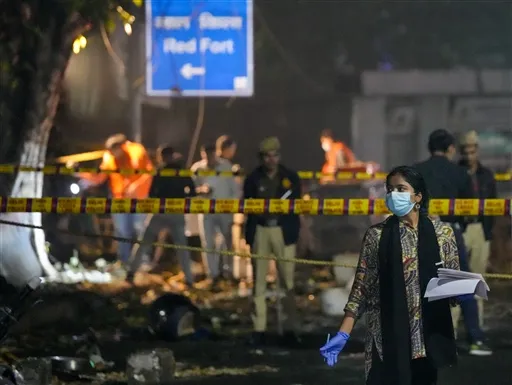
Was the Delhi blast caused by fertilizer-making chemicals?
ANFO, or ammonium nitrate fuel oil, was used in the November 10 bomb blast near the Red Fort in Delhi. According to media reports, sources cited preliminary investigation reports. The detonator was manually triggered to detonate the ANFO. According to official information, nine people were killed and 20 others were seriously injured in the blast.
you will know the answers to 5 questions related to ammonium nitrate fuel oil used in the Delhi blast…
Question 1: What is ammonium nitrate and how is it used to make dangerous explosives?
answer:Ammonium nitrate, or AN, has the chemical formula NH4NO3. It is an odorless, white, granular chemical. It was first prepared in the 17th century by the German chemist Johann Rudolf Glauber.
Synthetic ammonium nitrate is made by reacting ammonia and nitric acid. Industrial production began in the 20th century. Today, it is produced for industrial use in many countries around the world.
It is used in instant ice packs for irrigating wounds, in the chemical industry, and most commonly in the manufacture of fertilizers. Nitrate-based fertilizers are the most common in use worldwide.
AN is not an explosive in itself, but if it is mixed with diesel or any other fuel, it turns into a dangerous bomb.
For industrial use, ANFO is used for blasting in mines and for civil demolition purposes. Its explosion creates a large crater. The speed of the explosion can reach 14,000 kilometers per hour. The waves it produces are approximately five times faster than sound waves.

Question 2: How dangerous is ANFO, how much destruction can it cause?
answer:An ANFO explosion creates a large crater. The explosion can reach speeds of up to 14,000 km per hour. The waves it produces are approximately five times stronger than sound waves. This can instantly damage the ears and lungs. Furthermore, the explosion can send glass, iron, and bricks flying into pieces, ripping people apart. The explosion can also cause fires, collapse buildings, and release toxic gases into the air.
Ammonium nitrate explosions and fires release toxic gases such as nitrogen oxides (NOx) and ammonia, which can cause respiratory problems and burns.
One kilogram of ANFO is considered equivalent to 0.8 kilograms of TNT. It can create a crater 5-7 meters in diameter. The blast radius is approximately 30 meters. If an explosion occurs in a crowded area, dozens of people could be killed. Just 150 kilograms of ammonium nitrate can have an impact up to 1 kilometer. This explosion is so powerful that everything within a radius of 50-70 meters is destroyed.
The extent of the damage can vary depending on the amount of explosives and the number of people present at the site of the explosion.
For example, in 1995, an explosion in Oklahoma City, USA, using approximately 1800 kg (1 ton) of ANFO explosives, killed 168 people inside. An explosion of approximately 3000 kg of ammonium nitrate can blow up an entire large building or even an entire neighborhood. Everything within a radius of 50–70 meters would be flattened. Windows could shatter up to 500–600 meters. People could be injured or killed by flying glass and debris up to 200–300 meters away. The sound of the explosion could be heard several kilometers away.

Question 3: How much quantity of ANFO was used in the Delhi blast?
answer:Security agencies are currently investigating the matter. It has not yet been officially confirmed whether the blast was an ANFO-based IED or another explosive. However, videos released after the blast show orange smoke billowing from a car fire. Experts say that orange smoke is produced when ammonium nitrate explodes because it releases gases like nitrogen oxide and ammonia. Once mixed with air, nitrogen dioxide causes the smoke to appear orange. However, this can only be confirmed after forensic examination of samples taken at the scene.

Considering the intensity of the blast, it can be estimated that if it was ANFO, at least 100 kilograms of it was used. The blast’s waves were felt up to a distance of approximately 100 meters. The glass of several shops shattered. People present at the scene reported that the sound was so loud that it deafened people’s ears.
Question 4: How easy is it to buy ammonium nitrate and what are the rules for storing it?
answer:AN is primarily a nitrogen fertilizer, essential for farmers. India’s AN market was 822,000 tons in 2024, and will reach 997,000 tons by 2030. It sells at a subsidy of 20-30 rupees per kilogram from the Ministry of Agriculture. Because it has industrial uses, it is readily available at fertilizer stores and industrial centers.
However, according to regulations enacted in 2012, if ammonium nitrate is mixed with other chemicals, there are strict provisions. Under these regulations, emulsions, paints, or gels containing more than 45% ammonium nitrate by weight are classified as explosives. Because this explosive is also used in mining, licensing is required from the Petroleum and Explosives Security Organizations. Anyone without a license cannot purchase ANFO.

Question-5: How many terrorist attacks took place before this using ammonium nitrate bombs?
answer:The first major explosion involving an ANFO bomb occurred in Oklahoma City, USA, in 1995. The bomb used 1,800 kg of ANFO. The blast destroyed half a building and killed 168 people. Furthermore, in 2020, the explosion of approximately 3,000 kg of ammonium nitrate in Beirut caused massive devastation. A large area of the city was devastated, and approximately 200 people were killed.
Explosions and incidents involving ammonium nitrate (AN) in India
- 1985 Delhi serial blasts: On October 20, bombs exploded at seven locations in Delhi, Uttar Pradesh, and Haryana. The bombs were packed with picric acid and dry batteries into a small transistor-like device. Five people were killed and dozens injured. A live bomb was recovered from the scene. Khalistani groups were suspected of being involved in the blasts.
- Pune serial blasts, 2010: On February 13, bombs exploded near J.J. Hospital, Osho Ashram, and Sabri Society. The remains of an ANM were recovered from the site. Seventeen people were killed and more than 60 injured. The Indian Mujahideen was implicated in the attacks.
- Hyderabad Blasts 2007: AN traces were found in the attacks on Mecca Masjid and other locations in Hyderabad. Sixteen were killed and hundreds injured in 2007. The attacks were linked to SIMI.