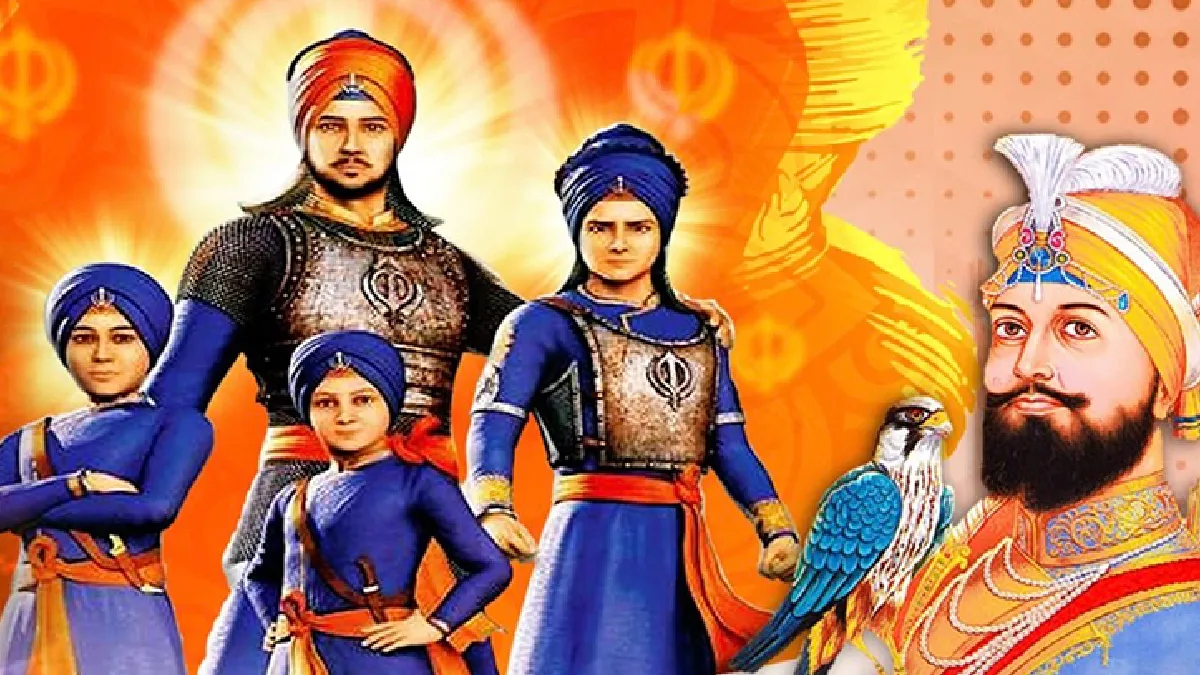
Recognize the hero who fights for the sake of religion.
Recognize the hero who fights for the sake of religion.
It’s a rare incident in world history that two children, aged nine and six, were buried alive in a wall by order of a ruler for refusing to convert. Yet, this is precisely what happened in Punjab nearly 320 years ago. On Veer Bal Diwas (December 26),……. Guru Gobind Singh Ji’s four sons and their elderly mother for the sake of protecting the religion.
- The unique sacrifice of Guru Gobind Singh’s sons
- Sons were bricked into the wall for not converting to Islam.
Shambhu Dayal Vajpayee. Nearly 320 years ago, in the bitter cold of December, an unparalleled chapter in the history of bravery and religious war was being written in Punjab. This chapter is about the self-sacrifice of Guru Gobind Singh’s four sons and their elderly mother. It is a rare incident in world history that two children, aged nine and six, were bricked alive into a wall by order of the ruler for refusing to convert. Hands bound, imprisoned and surrounded by drawn swords, Guru Gobind Singh’s two younger sons were engaged in a full-fledged battle against a powerful representative of the Mughal power. With their brilliance and determination, this was all they had.
One night in late December 1704, when Guru Gobind Singh left Anandpur Sahib on the promise of safe passage from Emperor Aurangzeb on the Quran and the cows of the hill kings, he feared what he had expected. The combined forces of the Mughals and the hill kings attacked him from behind. In the chaos of this treacherous attack, many Sikh soldiers were killed, and Guru Gobind Singh’s valuables, including books, works like the Vidyasagar, and literature translated from Sanskrit, were destroyed in the river. The Guru’s family was also scattered.
Tortured for two days
After this deception and chaos, Guru Gobind Singh Ji’s mother Gujri lost her way and along with her Guru Gobind Singh Ji’s two younger sons Baba Zorawar Singh aged nine and Baba Fateh Singh aged six were arrested and taken to Sirhind (District Fatehgarh Sahib). Nawab Wazir Khan, the Faujdar of Sirhind, had them kept in a high tower lying deserted on the banks of the river and open from all sides. Both the children and Mata Gujri spent the night shivering in the straw sitting in the severe cold. On the morning of 23 December 1705, leaving Mata Gujri there, the armed soldiers took both the boys to the Faujdar’s court. This sequence continued for two days.
A sacrifice chosen over temptation
To break the children’s morale, the Nawab also told them that their fathers, brothers, and others had been killed, and they would never see them again. If they agreed, they would enjoy a life of luxury. He persuaded them, tempted them, and threatened them with brutal execution. He told them to embrace Islam and they would be released. The children adamantly replied, “Kill me, but I won’t abandon my religion.” The Nawab was astonished; he had never seen such fearless and determined boys. They kept giving such stern replies that, in exasperation, he ordered them buried alive on the third day. These children had been awake for many nights and hungry for days, yet they were steadfast, their faces unwavering. The wall was razed, and they both died of suffocation. According to “Suraj Prakash” and “Gurbilas,” they were beheaded. It is said that the executioner beheaded them later, after the wall collapsed.
Two sons were sacrificed in the war.
Meanwhile, in the battle of Chamkaur on December 22, 1704, Guru Gobind Singh Ji’s two elder sons, 18-year-old Sahibzada Ajit Singh, 14-year-old Baba Jujhar Singh, and 37 Sikhs were martyred. This is a unique battle in world history, in which a Mughal army of nearly 100,000 could not reach Guru Gobind Singh Ji in Kachi Garhi even after a fierce battle. Guru Gobind Singh Ji was accompanied by his two elder sons and only forty Sikhs. Guru Gobind Singh Ji enthusiastically embraced his sons, patted their backs, and sent them to the battlefield with a group of four Sikhs. He also witnessed the sacrifice of his younger son after his eldest son.
Like their grandfather, the two boys, nine-year-old Baba Zorawar Singh and six-year-old Baba Fateh Singh, sacrificed their lives but not their religion. They were the sons of Guru Gobind Singh, the same Guru Gobind Singh whom, two and a half to three years after this incident, Aurangzeb’s successor and eldest son, Bahadur Shah, called “Pir of Hind,” meaning Saint of India. The 81-year-old grandmother, Mata Gujri, could not bear the shock of her two grandsons, Baba Zorawar Singh and Baba Fateh Singh, being buried alive in the wall. She passed away that very day upon hearing this news. She is the only name in world history who was the wife, mother, grandmother of a self-sacrificing martyr, and who herself sacrificed herself for Sikh principles.