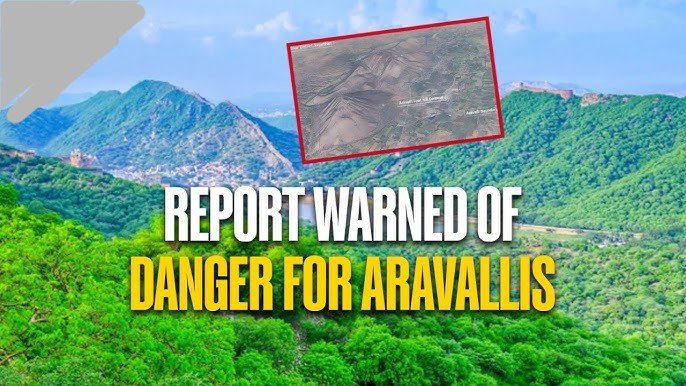
The centuries-old mountain range is facing danger, the invisible sentinel of Delhi-NCR is in danger.
The wounded Aravallis: The centuries-old mountain range is facing danger, the invisible sentinel of Delhi-NCR is in danger.

The air in Delhi-NCR is already toxic and suffocating. These days, even breathing in the open air is difficult. If the Aravalli Hills were gone, the sand and dust storms from Rajasthan would make Delhi’s air even more hellish. Environmental experts and doctors say that they act as an environmental shield. Continued mining and hill erosion are weakening this natural barrier.
Experts say this decision is a disregard for the environment. Protests are underway against this decision, as it could further increase pollution in Delhi. To protect the air quality of Delhi-NCR, preserving the Aravalli Range is essential, otherwise future generations will breathe toxic air.
Hope Resurfaces… Amidst the ongoing controversy over the Aravalli Range, the central government has canceled mining leases in the Aravalli region in all states. It also prohibited state governments from issuing new leases. The government clarified that the protected area will be expanded. A senior official stated that the government is fully committed to the long-term conservation of the Aravalli Range.
Now, a hearing is expected on January 7th.
Former Forest Conservator Dr. RP Balwan has filed an interlocutory application in the Supreme Court seeking reconsideration of this order, which is scheduled for January 7th. The Aravalli Virasat Jan Abhiyan has launched a signature campaign for a review petition on the Supreme Court order. In Haryana, the Aravalli ranges are present in Mewat, Faridabad, Palwal, Gurugram, Mahendragarh, Rewari, Charkhi Dadri, and Bhiwani. …
On November 30, 2002, the Supreme Court banned all mining in the Aravalli region. Prior to this, from 1990 to 1999, Panchayat community land was owned by the Forest Department, and Forest Department guards protected it. In 1999-2000, the land along the Aravalli region was given to the Panchayats. Following complaints of illegal mining, the Supreme Court’s Centralized Empowered Committee investigated the matter, which alleged political patronage. On March 18, 2004, the Supreme Court ruled that the Forest Act 1980 applies to deemed forests near the Aravalli region. Previously, in the Godavarman judgment of December 12, 1996, the Supreme Court clarified the definition of forest area and directed that forest land under any proprietary rights shall not be used for non-forestry purposes without the permission of the Forest Conservation Act 1980.
The Aravalli mountain range provides natural resources, air, water, livelihoods, and cultural traditions to the surrounding population. Nearly 20 villages in Faridabad, including Pali, Dhauj, Mangar, Silakhri, Mewala Maharajpur, Ankhir, Badkhal, Kot, Sirohi, Khori Jamalpur, and Mohabbatabad, depend on this mountain range. The Aravalli mountain range provides fodder, water, and open pastures for livestock. Villagers say that if the Aravalli mountain range is damaged, animal husbandry will be the primary source of damage, jeopardizing the livelihoods of thousands of families. This water, flowing through wild herbs and natural elements, also enhances soil fertility.
- The Aravalli Mountain Range is one of the world’s oldest fold mountain ranges, formed primarily during the Proterozoic Era, approximately 2.5 billion years ago. It was formed by the collision of tectonic plates and orogeny (mountain-building) processes. According to the Geological Survey of India (GSI) and other scientific studies, it is part of the Indian Shield, formed by the collision of ancient cratons.
The five thousand year old Parson Temple is located in the Aravalli Hills adjacent to Faridabad,
the place of penance of Sage Parashar .
The Mahant of the temple says that this is the place of penance of Sage Parashar.
It is believed that Maharishi Ved Vyas was also born at this place. No need for fertilizer Some farmers say that the water flowing down from Aravalli during the rainy season is so nutritious that there is no need to apply fertilizer to the crops.